
Although this parasite isn't my favorite, being that none are, it is quite interesting to say the least. The hook worm affects about 740 million people world wide according to the Centers for Disease Control and Prevention (CDC,2013). These particular parasites are small worms which attach themselves to the wall of the bowel , and may cause serious health concerns in humans. The parasite lives within the small intestines and passes its eggs through the feces of the infected individual . The hook worm is contracted through contaminated water or food items.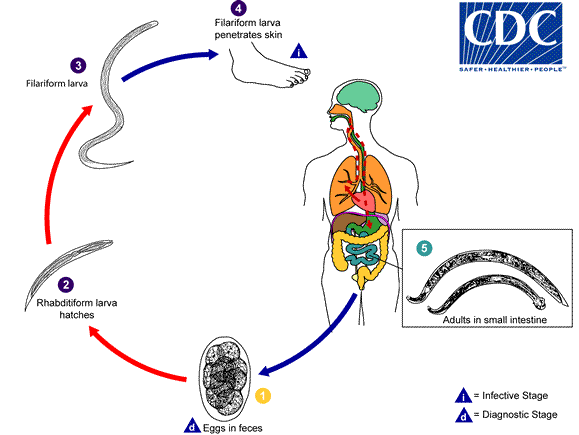
Being that the eggs are passed through an infected individuals feces , the larvae become flariform within 5- 10 days . The larvae are able to survive in unfavorable conditions for up to 3 weeks according to the CDC (CDC, 2013). When infecting the host , the parasite enter through the skin and are carried through the body by way of blood vessels. The larvae then make their way to the intestines where they have then matured into adult larvae. According to the CDC, most adult worms are eliminated within 1-2 years (CDC, 2013) .

Hook worms can be found in rural areas where sanitation is poor . Those who are infected with hook worms may experience symptoms which may cause heartache, dizziness, fatigue, a pale appearance, and dryness in the hair and skin. Those who contract the hook worm usually become anemic , and suffer from a low red blood count , which could potentially lead to heart failure in some individuals. Individuals infected are also at risk for developing ascites , which is a condition that causes fluid to build up around the abdominal area, as well as a significant protein loss.

Although medication is prescribed to treat the hook worms , physicians concentrate on improving the nutrition of the infected individual. Prescriptions which kill the parasite such as abendazole, and mebendazole may also be prescribed by physicians to treat the hook worms. To ensure that hook worms are not contracted through feces or the soil, individuals should be sure to wear shoes while outdoors , or in areas where the sanitation methods are poor.
http://www.healthline.com/health/hookworm#Prevention8
http://www.cdc.gov/parasites/Hookworm/

No comments:
Post a Comment